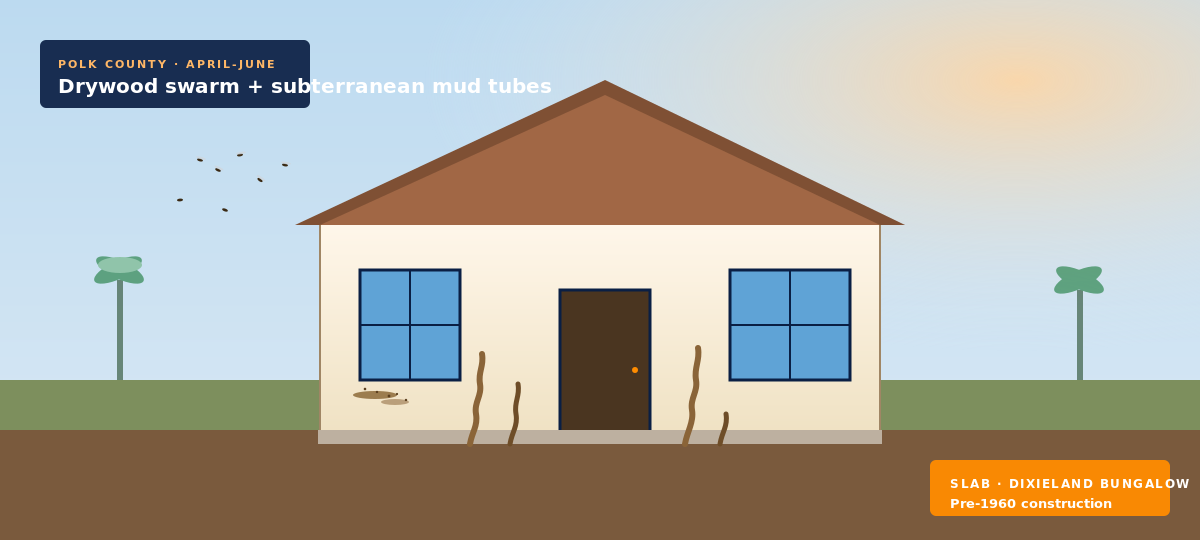
Spotted a mud tube running up a foundation wall, or a spring swarm of dark winged insects around a window in your Bartow home? Those are subterranean termites — the soil-dwelling species that causes the most structural damage in Polk County. Bartow’s older housing stock and clay-influenced soils make it a hotspot. Here’s how treatment works and how to get matched with a licensed pro.
Get matched with a Bartow termite pro
One call reaches a licensed, local exterminator who covers your address — and a real person answers, 24/7.
Why Bartow sits in heavy subterranean termite territory
Bartow is the county seat and one of the oldest continuously built communities in Polk County, and its housing stock reflects that: a historic core of frame and masonry homes around the courthouse district, mid-century neighbourhoods, and newer slab construction on the edges. Subterranean termites care a great deal about that mix, because the older the structure, the more opportunities it has accumulated for soil-to-wood contact.
The environmental case is straightforward and it applies to the whole region. Subterranean termites live in the soil and need constant moisture; Central Florida gives them warm soil year-round and a long wet season. They do not have a dormant winter here the way they do further north. Colonies forage continuously, and the practical consequence is that damage accumulates every month of the year rather than only during a season.
What is actually in the ground here
The native eastern subterranean termite is the baseline across Polk County. The more serious concern is the Formosan subterranean termite, an introduced species established in Florida including the Tampa Bay region and points inland. Formosan colonies are far larger than native colonies, forage over a wider area, and can build carton nests — a chewed-wood-and-soil material that holds moisture — which in some cases lets a colony sustain itself within a structure or a wall void with a reduced dependence on soil contact. Identification matters because it changes both urgency and treatment strategy. See subterranean vs. drywood termites in Polk County for how these differ from the other major group.
The warning signs that bring Bartow homeowners here
Mud tubes
Pencil-width to broader tubes of soil and faecal material running up a foundation wall, a pier, a slab edge, or the interior of a crawl space. They exist because subterranean termites cannot tolerate open air and low humidity — the tube is a portable, humid tunnel between the soil and the wood they are eating. A tube is not evidence of a small problem; it is evidence of an active, established foraging route. Breaking a short section open and checking a few days later for repair is a reasonable way to confirm the tube is currently in use, but it is not a substitute for an inspection.
Swarmers
Winged reproductives leaving an established colony to start new ones. Native eastern subterranean termites typically swarm in late winter through spring during daylight, often on a warm day after rain. Formosan termites typically swarm later in spring into early summer, at dusk, and are strongly attracted to lights — which is why homeowners find them at porch fixtures and window screens. Discarded wings on a windowsill, in a spider web, or around a light fixture are one of the most common first clues.
Damage indicators
Hollow-sounding or spongy wood at baseboards and door casings; paint that looks blistered or rippled over a stud or joist; sticking doors and windows; a small pinhole with mud packed into it; sagging or soft flooring. Subterranean termites eat wood from the inside and typically leave a thin intact surface, which is why damage is usually much further along than it looks when it is first found.
For a broader walkthrough of what to look for, see signs of termites, and for telling the two major groups apart, drywood vs. subterranean termites.
Conducive conditions to look for on a Bartow property
Most infestations trace back to a small number of correctable conditions: soil or mulch piled against siding above the slab line, wood siding or trim in direct ground contact, form boards left in place after construction, firewood and lumber stacked against the house, downspouts discharging at the foundation, an AC condensate line dripping at the slab edge, irrigation heads soaking the wall, a leaking hose bib, and an unsealed bath trap. Fixing these does not replace treatment, but leaving them in place undermines whatever treatment you buy.
How licensed treatment works
The inspection comes first
A thorough inspection covers the perimeter, the slab edge and expansion joints, plumbing penetrations and the bath trap, any crawl space, the attic, the garage, and accessible framing — and identifies species, extent, and conducive conditions. What it produces should be specific: where activity is, what is driving it, and what the recommended treatment addresses.
Liquid soil termiticide
A continuous treated zone is established in the soil around and beneath the structure, typically by trenching and rodding the perimeter and drilling through slab and hardscape where necessary. Modern non-repellent actives are the important development here: termites cannot detect the treated soil, so they move through it, pick up the active ingredient, and transfer it to nestmates through contact and grooming. That transfer effect is what pushes a liquid treatment beyond a simple barrier. The application is precise, label-driven work — volumes and placements are specified — and it is a substantial part of why this is licensed work.
Baiting systems
In-ground stations placed around the structure are monitored and, when hit, deliver a slow-acting insect growth regulator that foragers carry back and share, with the goal of eliminating the colony rather than only excluding it from the building. Baiting is often the better choice where drilling would be destructive, where slab construction or hardscape makes a continuous liquid zone difficult, or where a site has a history of repeat activity. It requires ongoing monitoring, which is a feature rather than a drawback: someone is looking at the property on a schedule.
Which one
Neither is universally correct. The choice depends on construction type, soil and slab conditions, the extent and location of activity, whether Formosan termites are involved, and what the homeowner wants from the arrangement long-term. A company that recommends the same product on every property regardless of what it found is not doing the inspection part of the job. For the wider treatment picture, see the complete termite treatment guide.
Bonds, warranties, and what you are actually buying
Termite work in Florida is normally sold with an ongoing agreement, and the distinction between types matters more than almost anything else in the paperwork:
- Retreatment-only — the company retreats at no additional charge if activity returns, but does not pay for damage
- Repair (damage) bond — the company also covers repair of new termite damage, subject to the terms, exclusions, and any caps written into the contract
Read what is excluded, what conditions void it, whether the annual renewal is required to keep coverage alive, and whether it transfers if you sell. Ask whether the initial inspection recorded existing damage, since pre-existing damage is normally excluded. And verify the company’s licence — termite work in Florida requires a pest control licence under Chapter 482 administered by the Department of Agriculture and Consumer Services, which publishes a public licence lookup.
Buying or selling in Bartow
A real-estate transaction usually involves a wood-destroying organism inspection, which is a specific, standardised inspection reported on a state form — not the same thing as a general home inspection, and normally performed by a differently qualified inspector. A home inspector is not required to identify termite activity, and a WDO report covers wood-destroying organisms specifically, including subterranean and drywood termites and wood-decay fungi. If you are buying an older Bartow home, treat these as two separate, both-necessary inspections. See WDO inspection for what that report covers.
What to do now
- Photograph and date what you found — tubes, wings, damaged wood — and leave it in place for the inspector to see
- Do not treat it yourself; retail products applied to a mud tube kill a few foragers, tell the colony to route around the area, and make a professional inspection harder to interpret
- Do not repair or paint over damaged wood before inspection, since the extent of damage is part of what determines the plan
- Clear access to the perimeter, crawl space, garage walls, and attic hatch
- Correct the conducive conditions listed above, particularly anything discharging water at the foundation
- Gather any prior termite paperwork — an existing bond, previous treatment records, or a prior WDO report changes the conversation considerably
For local context on why this region carries the pressure it does, see Polk County pest pressure, and for the rest of what Bartow properties deal with, pest control in Bartow.
Bartow subterranean termite FAQs
What’s the difference between subterranean and drywood termites?
Subterranean termites live in the soil, need constant moisture, and build mud tubes to reach wood, so treatment focuses on the soil and the structure’s connection to it. Drywood termites live entirely inside the wood they infest, need no soil contact, and leave distinctive hard faecal pellets, so treatment is directed at the wood itself. The two require different approaches, which is why identification comes before any treatment decision.
What do mud tubes mean?
They mean an active, established foraging route. Subterranean termites cannot tolerate open air and low humidity, so the tube is a humid tunnel between the soil and the wood they are consuming. Finding one is not evidence of a minor problem. You can break a short section and check days later for repair to confirm current use, but that is a confirmation step, not a substitute for inspection.
Is a termite bond worth it in Bartow?
It depends on which kind you are buying. A retreatment-only agreement covers further treatment but not damage repair; a repair or damage bond also covers repair of new termite damage subject to its terms and caps. Read the exclusions, what voids coverage, whether annual renewal is required to keep it alive, and whether it transfers on sale. Pre-existing damage recorded at the initial inspection is normally excluded.
Liquid barrier or bait system — which is better?
Neither universally. Liquid termiticide creates a continuous treated soil zone, and modern non-repellent actives add a transfer effect because termites cannot detect the treated soil and carry the active ingredient to nestmates. Baiting uses monitored in-ground stations delivering a growth regulator with the goal of colony elimination, and often suits properties where drilling would be destructive or slab and hardscape make a continuous zone difficult. The right answer follows from the inspection.
I’m buying a home in Bartow — do I need a termite inspection?
Yes, and it is a separate thing from the general home inspection. A wood-destroying organism inspection is a standardised inspection reported on a state form and normally performed by a differently qualified inspector; a general home inspector is not required to identify termite activity. Given Bartow’s older housing stock, treat them as two distinct and both-necessary inspections.
When do termites swarm around here?
Native eastern subterranean termites typically swarm from late winter through spring, during daylight and often on a warm day after rain. Formosan subterranean termites typically swarm later, spring into early summer, at dusk, and are strongly attracted to lights, which is why they turn up at porch fixtures and window screens. Discarded wings on a sill or in a web are a common first clue either way.
Should I spray the mud tubes myself while I wait?
No. Retail products applied to a tube kill a few foragers and prompt the colony to route around the treated area, which does nothing to the colony and makes the professional inspection harder to interpret. Leave tubes, wings, and damaged wood in place, photograph and date them, and let the inspector see the actual evidence.
What makes Formosan termites a bigger concern?
Colony size and behaviour. Formosan subterranean termites are established in Florida including the Tampa Bay region and inland, and their colonies are far larger than native colonies and forage over a wider area. They can also build carton nests from chewed wood and soil that retain moisture, which in some cases lets a colony sustain itself in a structure or wall void with reduced dependence on soil contact. That changes both urgency and strategy.
Protect the structure before it spreads
Tell us your address and what you’re seeing. We’ll match you with a licensed, insured Bartow company to schedule an inspection.
Last reviewed August 2026 · reviewed on a quarterly cycle. Lakeland Exterminators is a dispatch and matching service that connects Polk County homeowners with independent, FDACS-licensed pest-control companies; we are not a licensed pest control operator and do not perform treatments ourselves.
Disclaimer: Lakeland Exterminators is a local dispatch and referral service, not a licensed pest-control operator. We connect Polk County, Florida homeowners with independent, FDACS-licensed and insured pest-control companies. All inspections and treatments are performed by those independent providers, who set their own pricing, scheduling, and service terms.
Any reference to same-day, emergency, or 24/7 service describes the typical scheduling of matched independent providers and is not guaranteed; actual response times vary by provider, season, location, and demand.