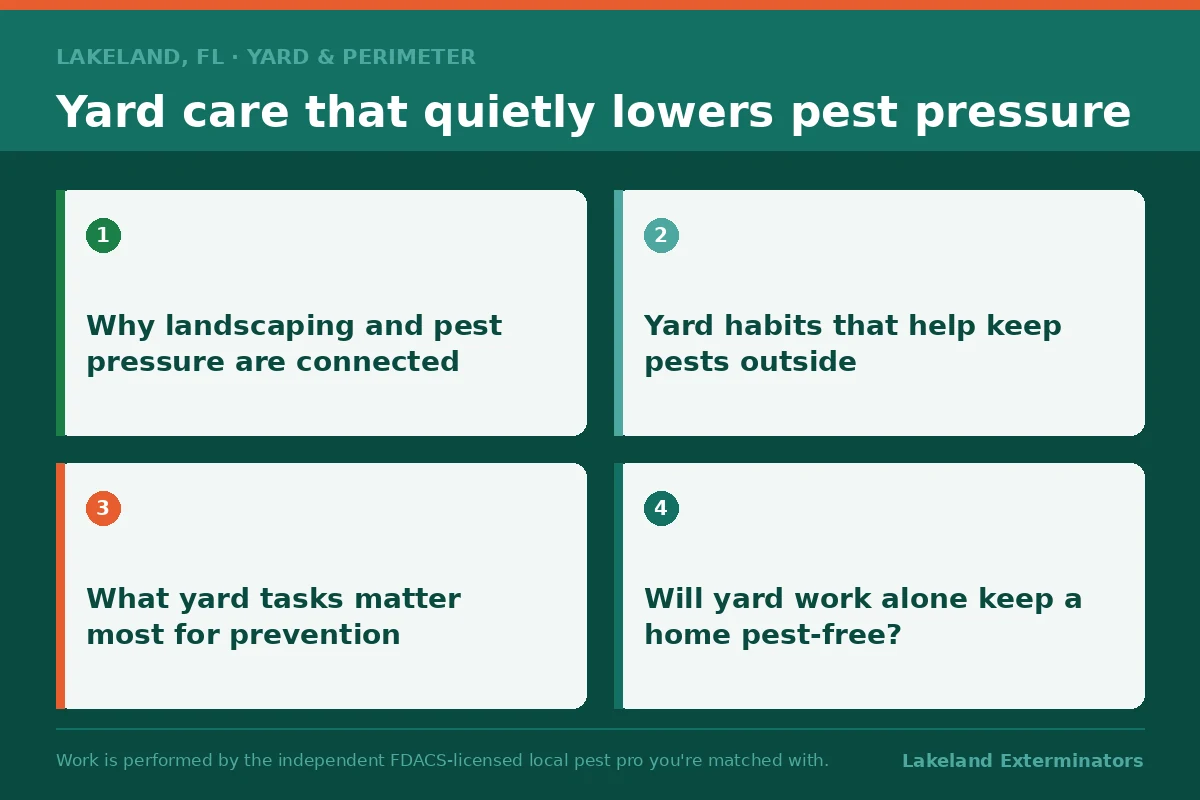
Most Lakeland homeowners think of pest control and yard care as two separate chores. In practice they are closely linked. A large share of the pests that end up indoors spend their lives in the yard first, and the condition of your landscaping decides how much pressure ever reaches the foundation. Good routine yard care does not replace pest control, but it removes a lot of the harborage and moisture that draw pests toward the house in the first place.
Dealing with a pest problem right now?
📞 Call now — get matched with a licensed local exterminator: (888) 295-0220When you call, stay on the line for a few seconds while we match you with the licensed local exterminator for your area. Have your address and a quick description of the problem ready.
Licensed local pros · Fast response, subject to availability · No obligation
Why landscaping and pest pressure are connected
Insects and rodents follow shelter, moisture, and a path to the structure. Tall grass, dense shrubs touching the siding, leaf litter, wood piles, and old stumps all give them cover. Poor drainage and overgrown beds hold the humidity that ants, roaches, and mosquitoes prefer in our Polk County climate. Trim those conditions back and you shrink both the habitat and the bridges pests use to reach your walls.
Yard habits that help keep pests outside
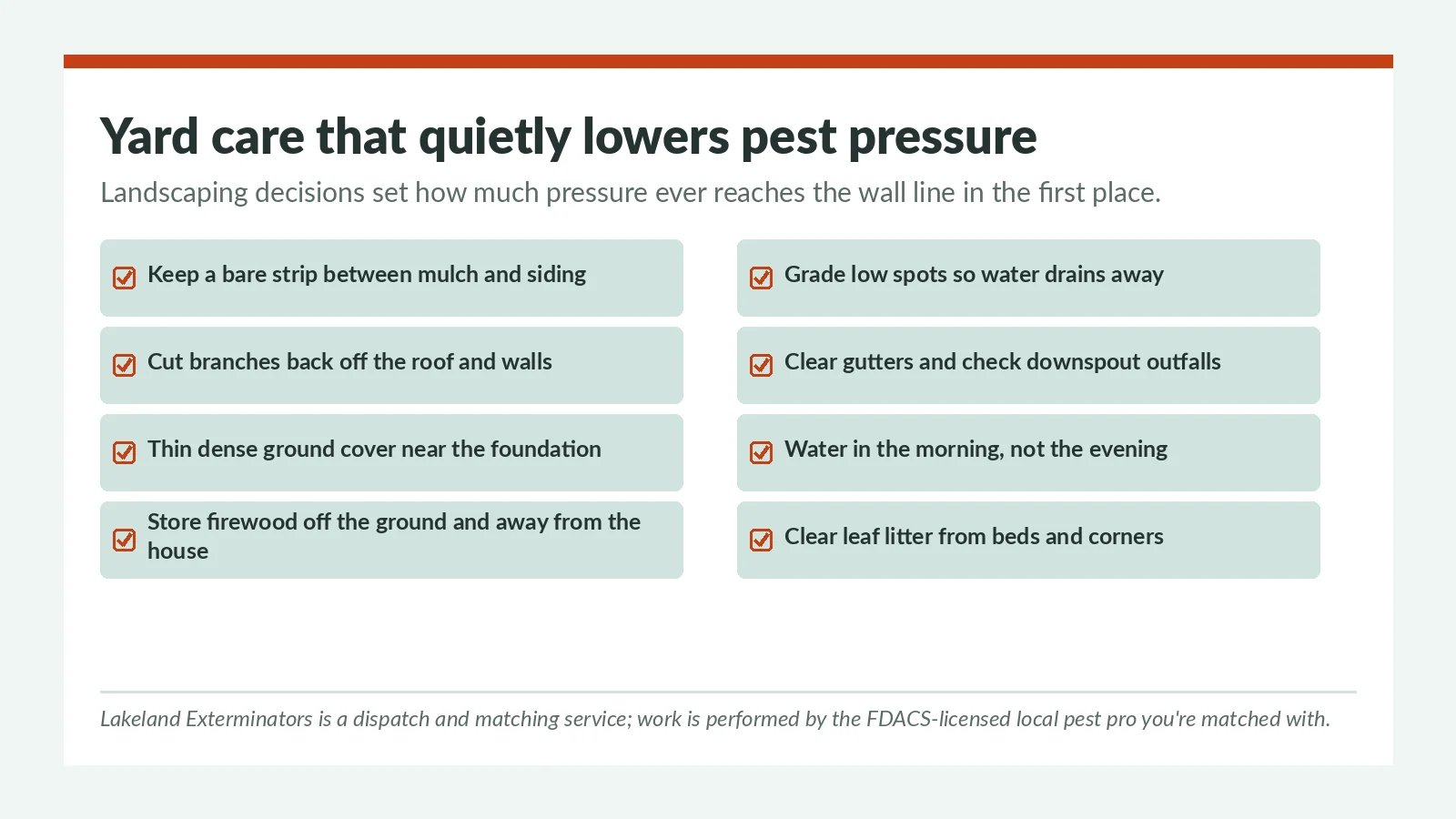
- Keep grass cut and edges clean. Regular mowing and edging remove the humid, shaded layer where fleas, ticks, and ants thrive near walkways and the foundation.
- Pull vegetation back off the house. Shrubs and branches touching siding or the roofline act as direct highways indoors. A clear gap of a foot or more between plants and the structure removes that bridge.
- Clear brush, leaf litter, and debris. Heavy undergrowth and piles of yard waste are prime harborage. Clearing them, including heavy brush removal where a lot has accumulated, takes away the cover.
- Deal with old stumps and wood-to-soil contact. Decaying stumps and buried wood attract termites and other wood-feeding insects. Grinding stumps out removes a food source close to the home.
- Watch drainage and standing water. Grading that pushes water away from the foundation, and clearing low spots that pond after a storm, cuts the standing water that breeds mosquitoes and keeps soil damp.
The three-foot band that decides most of it
If you only maintain one part of the property with pests in mind, make it the strip of ground within about three feet of the exterior wall. Nearly every pest that gets indoors stages there first, and it is the one zone where a homeowner’s ordinary yard decisions have an outsized effect:
- Keep it dry and visible. A two- to three-inch gap of bare soil, rock, or shell between the mulch line and the stucco keeps the base of the wall dry and, just as importantly, keeps it visible — that band is exactly where subterranean termite mud tubes would appear. Bury it under four inches of damp mulch and you have removed your earliest warning sign.
- Cap mulch depth at about two inches. Deeper mulch stays damp between rains and becomes continuous harborage for palmetto bugs, earwigs, millipedes, and ants. Cypress and pine bark hold moisture longer than pine straw; rock or rubber in the first band solves it permanently.
- Choose the plants in that band deliberately. Dense evergreen shrubs planted tight to the wall create a permanently shaded, humid pocket that never dries. Spacing plants so air and light reach the wall matters more than which species you pick.
- Watch the irrigation heads. A head that sprays the stucco or soaks the first foot of bed on every cycle creates a scheduled wet zone. Walking the yard during a run cycle, rather than after, is the only reliable way to catch a misaimed head.
Drainage, grading, and the Polk County water table
Polk County’s wet season runs roughly late May into early October, with near-daily afternoon storms, and the county sits within the Southwest Florida Water Management District, whose day-of-week irrigation schedule concentrates applied water into a couple of mornings a week. Between the two, the ground around a Lakeland house gets wet on a predictable rhythm. What matters is how fast it dries:
- Slope away from the slab. The usual target is a fall of about six inches over the first ten feet. Settled beds and years of added mulch quietly reverse that grade on a lot of older Lakeland homes.
- Extend the downspouts. A downspout discharging at the corner of the slab creates the wettest soil on the property in the one place it is least helpful. Extensions carrying discharge four to six feet out, or into a drain line, change the moisture profile of the whole corner.
- Fix the spots that hold water more than a day. A low corner that ponds after every storm is both a mosquito source and a chronic soil-moisture problem next to the foundation.
- Check the AC condensate line. Florida air conditioners generate a remarkable volume of water. A line discharging into a bed keeps that bed permanently damp year-round, independent of rain.
- Clear the gutters. Overflowing gutters concentrate roof water at the wall line and keep the fascia damp, which is a classic path into carpenter ant and wood-decay problems.
Wood, mulch, and what termites read as food
Subterranean termites are active in Polk County year-round, and yard maintenance is where most of their access is either created or removed:
- Wood-to-soil contact is the headline item. Fence posts, deck posts, landscape timbers, railroad ties, buried form boards left from construction, and the bottom step of a wooden stair are all direct routes from soil to structure.
- Stumps and buried roots. A ground-out stump still leaves a substantial root mass decaying underground. Within about fifteen feet of the slab, that is a colony site with a short walk to the house.
- Firewood and lumber storage. Off the ground, off the wall, and ideally not against the house at all. Stacked against a wall it is both food and a covered bridge.
- Palm boots and dead fronds. Retained frond bases on palms hold moisture and debris and are a favorite roof-rat and roach harborage, often at roof height.
- Construction debris in beds. Scrap plywood, stakes, and form lumber buried during the build are extremely common finds in newer Polk County subdivisions and are frequently where a first infestation starts.
Our page on pest control for new construction in Lakeland covers the buried-debris problem in more detail, and signs of termites in Lakeland covers what to look for at the wall line.
The lawn itself: turf, thatch, and chinch bugs
Most Lakeland lawns are St. Augustine grass, which comes with its own set of consequences. Heavy thatch — the dense layer of stems and runners between the green blades and the soil — holds humidity, binds up insecticide before it reaches soil level, and provides habitat for a range of insects including lovebug larvae. Mowing high, at roughly three and a half to four inches for St. Augustine, produces deeper roots and a more drought-tolerant lawn than scalping does, and drought-stressed turf is exactly what southern chinch bugs exploit.
Chinch bug damage is the most-misdiagnosed lawn problem in Polk County: it appears as expanding yellow-to-straw patches, usually starting in the hottest, driest, most sun-exposed part of the lawn near pavement, and it looks almost exactly like drought stress. The difference is that watering does not bring it back. Fire ant mounds, by contrast, tend to appear soonest in thin or stressed turf, so a healthy stand of grass makes them both less frequent and much easier to spot early. Our lawn pest control page for Lakeland covers turf pests specifically.
Worth knowing about licensing: in Florida, lawn and ornamental pest control is a separate FDACS license category from general household pest control, and structural termite work is a third. A company that treats your turf may not be the company licensed to handle a termite finding, and vice versa. That is a question worth asking rather than assuming.
A seasonal yard-care rhythm for Polk County
- Spring. Cut back the winter growth that has crept toward the siding, re-establish the bare band at the foundation, refresh mulch to depth rather than adding on top of old mulch, and check irrigation heads before the schedule ramps up.
- Summer. Mow on a consistent schedule and keep the height up, clear gutters before storm season peaks, and walk the yard every few days for containers holding water.
- Fall. After the last storms, pull accumulated debris off beds, trim limbs back six to eight feet from the roof, and clear any leaf load from valleys and gutters before the rodent-movement season.
- Winter. The best window for the heavier structural work — stump grinding, brush clearing, regrading a settled bed, replacing wood in ground contact — because pest pressure is at its annual low and the ground is workable.
A local lawn-and-landscaping company in Lakeland
Most of this is ongoing maintenance, and a lot of homeowners would rather hand it to a local crew. One Polk County company we point homeowners to for that work is Curb Appeal Lawn & Landscaping, run by Cathy Bergeron here in Lakeland. Alongside routine mowing, edging, and shrub trimming, they handle the heavier jobs that matter for pest pressure: forestry mulching and heavy brush clearing, stump grinding, and power washing. Keeping the yard maintained on a regular schedule is one of the steadier ways to hold pest activity down before it ever reaches the door.
Already seeing pests make it indoors?
One call reaches a licensed, local exterminator who covers your address — and a real person answers, 24/7.
Frequently asked questions
Does landscaping really affect pests inside the house?
Yes. Vegetation touching the structure, heavy brush, leaf litter, old stumps, and standing water create the harborage and moisture pests need, and they form the bridges pests use to reach the walls. Maintained landscaping reduces both.
Will yard work alone keep my home pest-free?
No. Good yard care lowers pressure but does not replace treatment. For an active infestation, the work is performed by an independent, FDACS-licensed pest-control company.
What yard tasks matter most for pest prevention?
Routine mowing and edging, pulling plants back off the siding, clearing brush and debris, grinding out old stumps, and correcting drainage so water moves away from the foundation.
How far back should mulch be kept from the house?
Leave a two- to three-inch gap of bare soil, rock, or shell between the mulch and the stucco, and keep mulch to about two inches deep. That keeps the base of the wall dry and, just as importantly, visible, since that band is exactly where subterranean termite mud tubes would show up.
How high should I mow a Lakeland lawn?
St. Augustine, the dominant turf across Polk County, does best at roughly three and a half to four inches. Mowing high produces deeper roots and better drought tolerance, and drought-stressed turf is what southern chinch bugs exploit first. Scalping a Florida lawn tends to create the exact conditions that lead to a turf-pest call.
Do stumps really attract termites?
A decaying stump and its root mass are a food source and potential colony site. Within about fifteen feet of the slab that matters, because a subterranean colony established there has a very short distance to travel to the structure. Grinding removes the visible stump but leaves roots, so proximity to the house is the thing to weigh.
Is the company that treats my lawn the same one that handles termites?
Not necessarily. In Florida, lawn and ornamental pest control, general household pest control, and structural termite work are separate FDACS license categories. It is worth asking which categories a company holds rather than assuming one visit covers all three.
Related Polk County reading
- Lawn pest control — Lakeland, FL
- Polk County pest prevention guide
- Signs of termites — Lakeland
- Pest control for new construction — Lakeland
- Fire ant control — Lakeland
- Mosquito control — Lakeland
- Rodent exclusion — Lakeland
- FDACS pest control licensing in Florida
Disclaimer: Lakeland Exterminators is a local dispatch and referral service, not a licensed pest-control operator. We connect Polk County, Florida homeowners with independent, FDACS-licensed and insured pest-control companies. All treatments are performed by those independent providers, who set their own pricing, scheduling, and service terms. Curb Appeal Lawn & Landscaping is an independent company mentioned here as a local resource; we are not affiliated and receive no payment for the mention.
Any reference to same-day, emergency, or 24/7 service describes the typical scheduling of matched independent providers and is not guaranteed; actual response times vary by provider, season, location, and demand.