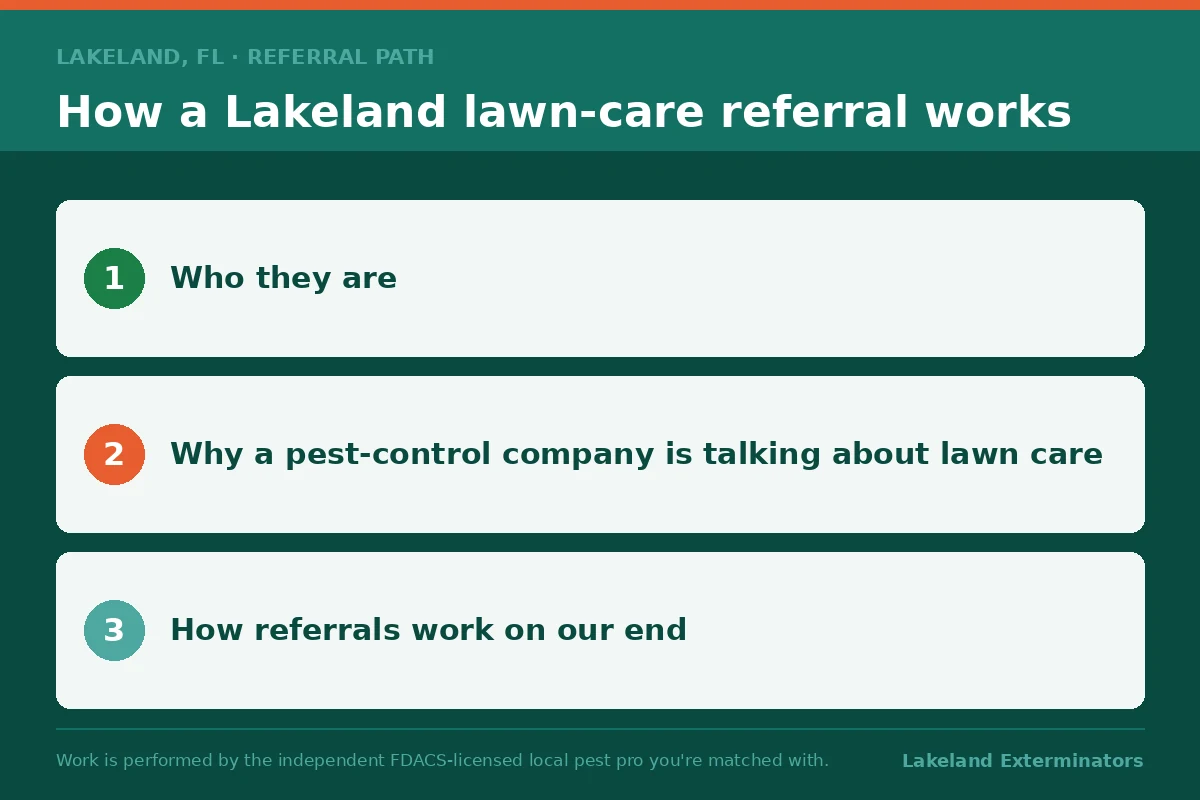
At Lakeland Exterminators, we connect Polk County homeowners with independent, licensed pest-control pros — that’s the whole job. We don’t cut grass, lay mulch, or grind stumps, and we’re upfront about it. So when a homeowner asks us who handles the lawn-and-landscape side, we like having a local name we can hand over without hesitation.
Dealing with a pest problem right now?
📞 Call now — get matched with a licensed local exterminator: (888) 295-0220When you call, stay on the line for a few seconds while we match you with the licensed local exterminator for your area. Have your address and a quick description of the problem ready.
Licensed local pros · Fast response, subject to availability · No obligation
One of those names is Curb Appeal Lawn & Landscaping Enterprises LLC.
Who they are
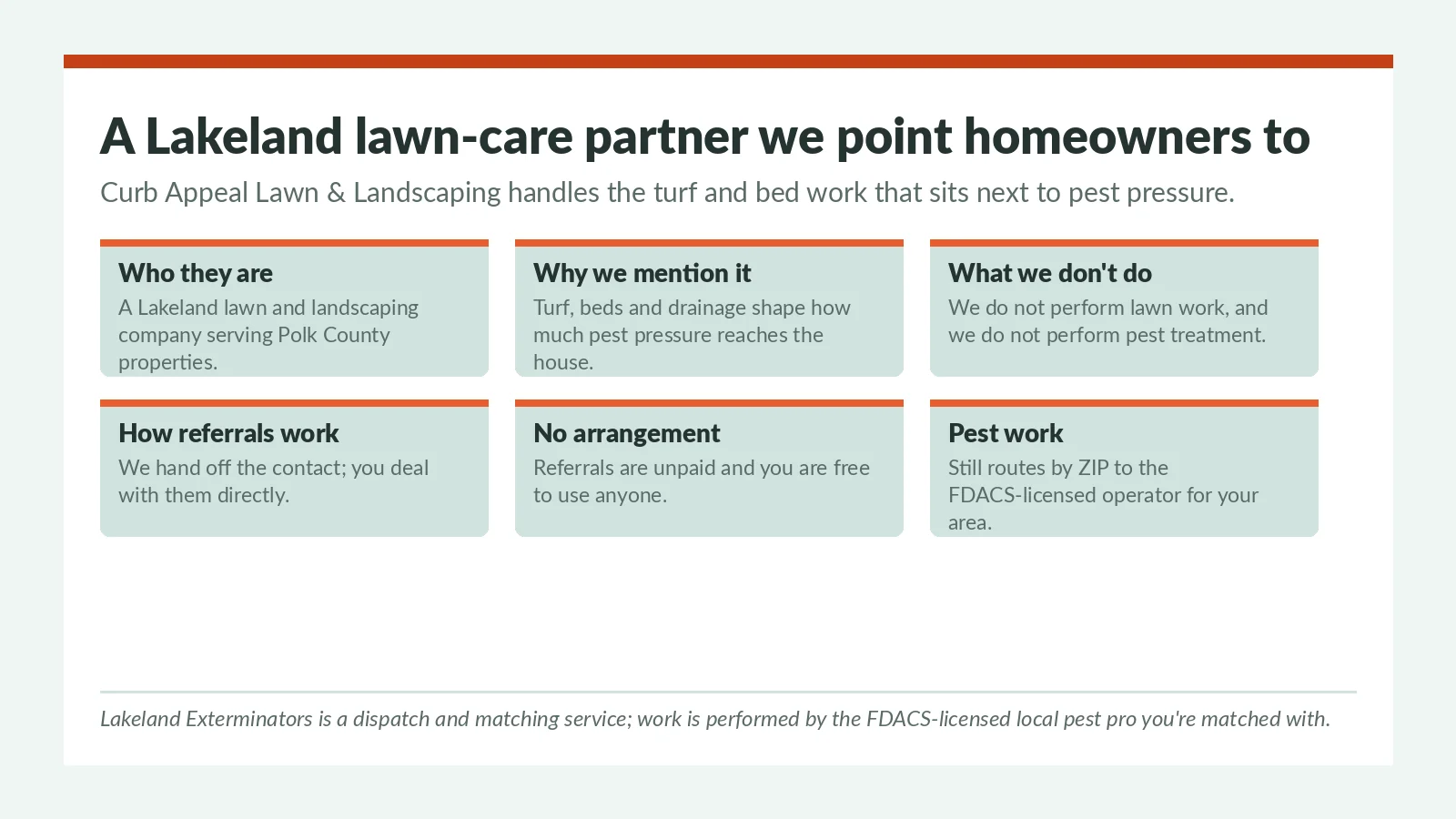
Curb Appeal is a women-owned, Lakeland-based lawn and landscaping company serving Polk County homeowners. Their teams handle the regular-maintenance work that keeps a yard looking sharp — mowing, edging, trimming, shrub work, and blow-downs — along with bigger projects like power washing, forestry mulching, stump grinding, and dump-trailer hauling and rental.
You can reach them here:
- Website: curbappeallakeland.com
Why a pest-control company is talking about lawn care
Bugs and rodents don’t respect the property line between “the lawn” and “the house.” A lot of what we get called about actually starts out in the yard:
- Mosquitoes need standing water. Clogged gutters, low spots, and overgrown beds hold moisture and give mosquitoes a place to breed. A well-kept yard with good drainage and trimmed vegetation reduces that breeding habitat before anyone reaches for a treatment.
- Fire ants and turf go together. Mounds tend to show up soonest in stressed or patchy grass. Healthy, maintained turf makes them easier to spot and treat early.
- Mulch placement matters. Mulch is good for plants, but piled directly against the slab it holds moisture near the foundation, which can invite termites and roaches. Where and how it’s placed is a landscaping decision as much as a pest one.
- Overgrowth gives rodents cover. Tall grass, brush piles, and shrubs touching the wall give rats and mice shaded cover right up to the house. Keeping the perimeter trimmed removes that runway.
When the yard is handled well, our side of the work gets easier — and your home stays more comfortable. That’s why we’re glad to send homeowners Curb Appeal’s way.
Where the trade line actually falls in Florida
This is not just a preference about who does what. Florida draws a legal line through the middle of “yard work,” and homeowners are routinely surprised by where it sits.
Under Chapter 482 of the Florida Statutes, administered by FDACS, applying pesticides for hire falls into distinct license categories. Lawn and ornamental covers pest, weed and disease control on turf and landscape plants. General household pest control covers the insects and rodents in and around the structure. Termite and other wood-destroying organisms is a third category with its own requirements. A company can hold one, two, or all three — and a landscape-maintenance company that mows, edges, trims, mulches, hauls, grinds stumps and power-washes may hold none of them, because none of that work requires a pesticide license.
The practical consequences:
- A mowing and landscaping crew can legally do everything that shapes the habitat — cutting, trimming, clearing, grading beds, removing wood — and that habitat work is a large share of what determines pest pressure
- Applying a product to your turf for chinch bugs or fire ants for hire is a licensed activity, and the license category is not the same one a structural pest company necessarily holds
- The company treating inside your home for roaches is not automatically the company that should be diagnosing a dying patch of St. Augustine, and vice versa
- All of these licenses are publicly verifiable, which makes “who is licensed for what” a two-minute question rather than a matter of trust — see our page on FDACS pest control licensing in Florida
None of that is a knock on any trade. It is simply why we hand the landscape side to a landscape company and route pest work to a licensed operator, rather than pretending one visit covers both.
The landscape decisions that move pest pressure most
Some yard work is cosmetic and some of it materially changes what reaches your walls. In rough order of impact for a Polk County property:
- Limb clearance from the roof. Roof rats are climbers, not burrowers, and an overhanging limb, a trellis, or a run of cable is a bridge to the soffit line. Six to eight feet of clearance from the roof edge does more than any bait station.
- The foundation band. Pulling shrubs back off the siding and keeping a narrow strip of bare soil or rock at the wall keeps the base of the wall dry and visible, which is exactly where subterranean termite mud tubes would appear.
- Wood removed from soil contact. Stumps, buried roots, landscape timbers, old fence posts and construction scrap left in beds are all food sources within walking distance of the slab. Stump grinding and debris hauling are landscape jobs with a direct termite consequence.
- Mulch depth and placement. About two inches deep, pulled back a few inches from the wall. Deeper mulch pressed to the stucco is continuous damp harborage for palmetto bugs, earwigs, millipedes and ants.
- Brush and thatch reduction. Heavy undergrowth and a thick thatch layer hold humidity, shelter rodents and turf insects, and bind up any product applied to the lawn before it reaches soil level. Forestry mulching and heavy clearing change that at a scale hand tools do not.
- Drainage correction. Regrading a settled bed and getting downspout discharge four to six feet away from the slab removes the wettest soil on the property from the one place it hurts most.
Notice that none of those six items involve applying anything. They are all maintenance and site work — which is precisely why a good landscape crew on a regular schedule reduces pest pressure whether or not anyone is treating.
Coordinating the two so they do not work against each other
Where homeowners lose ground is scheduling. A few points of friction come up repeatedly in Polk County yards:
- Do not mow, edge, or blow the perimeter the day after an exterior barrier treatment. A residual application along the foundation and bed line is meant to stay where it was put. Blowing debris across it or scalping the strip right afterward shortens it considerably. Ask the operator for a window and give the landscape crew the same date.
- Tell the lawn company if fire ant baits are down. Baits need foraging workers to find them and carry them in. Watering the bait in, or mowing over freshly applied granules, undercuts it.
- Irrigation timing matters both ways. Polk County sits in the Southwest Florida Water Management District, whose day-of-week schedule concentrates watering into a couple of mornings. An exterior treatment applied hours before a scheduled irrigation run gets diluted; a misaimed head that soaks the foundation band creates a permanent wet zone no treatment fixes.
- Flag the mulch refresh. Adding fresh mulch on top of old, year after year, is how a bed quietly rises above the stucco line and buries the termite inspection band. A refresh is the right moment to remove and reset rather than add.
- Report what the crew sees. A landscape crew is on the property more often than anyone else and is well positioned to notice a mud tube on a pier, a new fire ant mound at the slab, a rat run through the ground cover, or a soffit gap. That observation is worth passing along.
Two things a landscape company should not be asked to diagnose
A dying patch of St. Augustine. Southern chinch bug damage and drought stress look nearly identical — expanding yellow-to-straw patches, usually starting in the hottest and most sun-exposed part of the lawn near pavement. The distinguishing feature is that watering does not bring chinch bug damage back. It is also confused with fungal disease, nematodes, and simple irrigation coverage gaps. That is a lawn-and-ornamental diagnosis, not a mowing question. Our lawn pest control page for Lakeland covers the turf pests specifically.
Anything involving wood damage. If a crew grinding a stump or replacing a fence post turns up what looks like termite activity, that is the point to stop and get an FDACS-licensed inspection rather than treating it as a carpentry problem. Wood-destroying-organism work in Florida is separately regulated and documented on the state DACS-13645 form — see WDO inspections in Lakeland.
Frequently asked questions
Can my lawn company treat my yard for fire ants or chinch bugs?
Only if they hold the appropriate FDACS license. In Florida, applying pesticides to turf and ornamentals for hire falls under the lawn and ornamental category of Chapter 482, which is separate from general household pest control and separate again from termite work. Many landscape-maintenance companies hold none of those, because mowing, trimming, mulching, hauling and stump grinding do not require a pesticide license. It is a fair question to ask directly.
Should I schedule lawn service and pest control on the same day?
Generally no. An exterior barrier application along the foundation is meant to stay in place, and mowing, edging or blowing that strip immediately afterward shortens how long it lasts. Ask the operator how long to wait and give the landscape crew the same date.
Will better lawn care get rid of an infestation I already have?
No. Landscape maintenance lowers the pressure reaching the structure and makes treatment hold longer, but an established infestation is handled by an independent, FDACS-licensed pest-control company. The two are complementary, not interchangeable.
Does Lakeland Exterminators get paid for these referrals?
No. We do not take payment to recommend anyone, and the companies mentioned here are independent businesses with no affiliation to us.
Related Polk County reading
- Lawn pest control — Lakeland, FL
- Fire ant control — Lakeland
- Mosquito control — Lakeland
- Polk County pest prevention guide
- Signs of termites — Lakeland
- Rodent exclusion — Lakeland
- WDO inspection — Lakeland
- FDACS pest control licensing in Florida
How referrals work on our end
We’re a dispatch-style service: a Polk County homeowner contacts us, and we connect them with an independent licensed pest-control pro who fits the job. We don’t take payment to recommend anyone, and we only point people toward trades we’d be comfortable using on our own homes. Curb Appeal earned a spot on that short list.
If you’re a Lakeland homeowner getting your property in shape this season — pest control on our side, lawn and landscape on theirs — you’ve now got both ends covered.
Looking for help with pests or rodents in Polk County? Contact Lakeland Exterminators and we’ll connect you with a licensed local pro. For lawn care and landscaping, reach Curb Appeal Lawn & Landscaping at curbappeallakeland.com.
Disclaimer: Lakeland Exterminators is a local dispatch and referral service, not a licensed pest-control operator. We connect Polk County, Florida homeowners with independent, FDACS-licensed and insured pest-control companies. All inspections and treatments are performed by those independent providers, who set their own pricing, scheduling, and service terms.
Any reference to same-day, emergency, or 24/7 service describes the typical scheduling of matched independent providers and is not guaranteed; actual response times vary by provider, season, location, and demand.