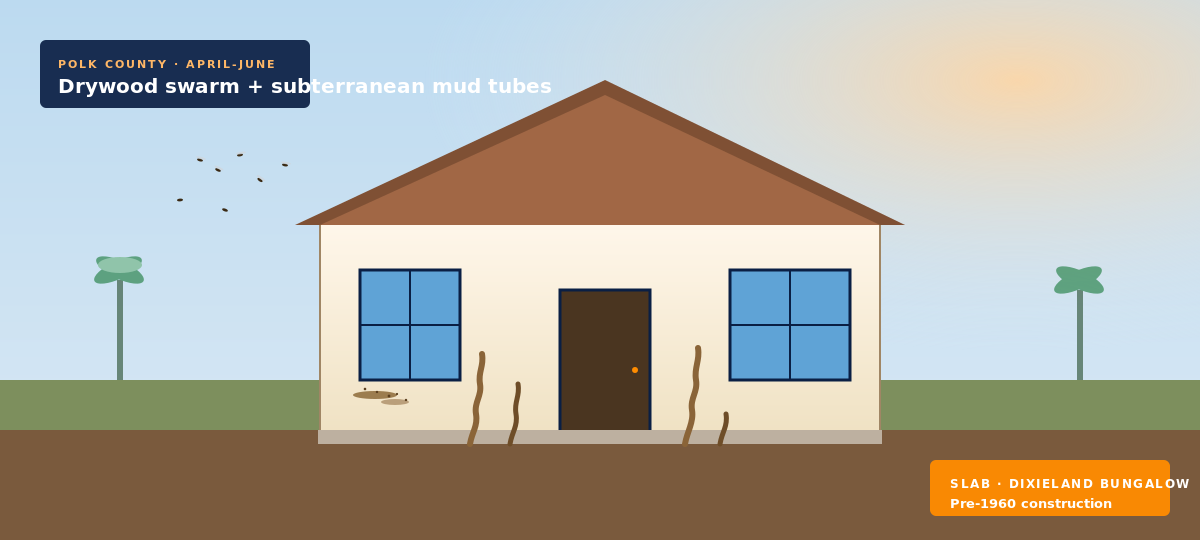
If you’ve found mud tubes along a baseboard, spotted a pile of what looks like sawdust under a window frame, or you’re pricing a treatment before a sale, the first question is almost always the same: what is this going to cost? In Lakeland and across Polk County, the honest answer is “it depends” — and the things it depends on are worth understanding before you compare quotes.
Dealing with a pest problem right now?
📞 Call now — get matched with a licensed local exterminator: (888) 295-0220When you call, stay on the line for a few seconds while we match you with the licensed local exterminator for your area. Have your address and a quick description of the problem ready.
Licensed local pros · Fast response, subject to availability · No obligation
This guide walks through the price ranges Polk County homeowners commonly see, why subterranean and drywood termites get treated (and priced) differently, and the specific questions that make competing quotes actually comparable. Every figure below is third-party industry data — a general sense of what Florida exterminators typically charge. It is not a quote. Your quote is between you and the exterminator who inspects your home.
Why Central Florida is heavy termite country
Termites are a year-round reality in Central Florida, not a seasonal nuisance. Our warm, humid climate, sandy soils, and long stretches without a hard freeze give termite colonies the conditions to stay active around the calendar. For homeowners in Lakeland, Winter Haven, Bartow, Auburndale, and the surrounding Polk County communities, that means the question is usually less “will I ever deal with termites?” and more “when, and which kind?” Homeowners specifically in Bartow dealing with active mud tubes can see how that soil-based treatment plays out on our subterranean termite treatment in Bartow, FL page.
And the “which kind” matters, because Central Florida hosts two very different groups of termites:
- Subterranean termites live in the soil and travel up into a structure through mud tubes they build for moisture and protection. They need soil contact, which is why you’ll often see those pencil-width mud tubes on foundation walls, piers, or slab edges.
- Drywood termites don’t need soil contact at all. They live entirely inside the wood they’re eating — framing, trim, furniture, attic members — and announce themselves with small piles of pellet-like droppings (frass) rather than mud tubes.
That second group is the reason so many local searches are for “no-tent” or “localized” termite treatment. Because drywood colonies can be confined to specific areas of a home, there are situations where a targeted treatment is an option instead of whole-structure fumigation. Whether that applies to your home is exactly the kind of thing an inspection determines.
Typical price ranges Polk County homeowners see
Below are general industry ranges. Treat them as a planning tool, not a price sheet. Actual cost depends on the size and construction of the home, the type and extent of the termites, the treatment method, and what the inspector finds.
Inspection / WDO report
A termite or WDO (wood-destroying organism) inspection is usually the most modest line item — commonly a low, flat fee, and in many real-estate transactions it’s a routine part of the process. The inspector examines the structure, documents any active or past infestation and conditions conducive to it, and issues a written report (often called the “termite letter” in a home-sale context). A WDO inspection in Polk County follows this same process countywide, not just in Lakeland proper.
If you’re buying or selling, this report does double duty: it tells you the condition of the home and it satisfies a requirement many lenders impose at closing. If a WDO report is on your radar for a transaction, the dedicated WDO inspection page for Lakeland and Polk County covers what’s involved and how to time it.
Liquid barrier / no-tent localized treatment
This is the band most homeowners are pricing when they search “termite treatment cost.” Liquid soil treatments (a treated zone around and under the structure, common for subterranean termites) and localized “no-tent” treatments for confined drywood activity commonly run from the mid-hundreds into the low four figures — a range that reflects everything from a small spot treatment up to a full liquid barrier on a larger home, depending on the home and the scope.
The spread is wide because the work varies so much. A spot treatment for a small area of drywood activity sits at the lower end. A full liquid barrier around a larger slab home with extensive subterranean pressure sits higher. Construction type, square footage, and accessibility all move the number. If a localized drywood approach is what you’re weighing, the no-tent termite treatment page for Lakeland explains when that option is and isn’t on the table.
Bait systems
In-ground bait systems — stations installed around the perimeter that termites feed on and carry back to the colony — typically cost more than a one-time liquid treatment, both because of the initial installation and because they’re designed to be monitored over time. For some homes and some types of pressure, a baiting program is the approach an exterminator recommends; for others, a liquid barrier makes more sense. The right choice is a judgment the inspecting professional makes based on what they see at your property.
Annual bond / renewal
Many Polk County homeowners carry a termite bond — an ongoing agreement that typically bundles periodic re-inspection and continued protection. Annual renewals are typically a modest recurring fee compared to the initial treatment, though the exact figure and what it covers is set by the operator holding the bond. Bonds vary a lot in what they actually cover, so the renewal price alone doesn’t tell you whether two bonds are comparable. Letting a bond lapse has real costs of its own — see the real cost of skipping a termite bond in Polk County for a numbers-based look at that tradeoff. (More on what to ask about a bond below.)
What moves your termite number up or down
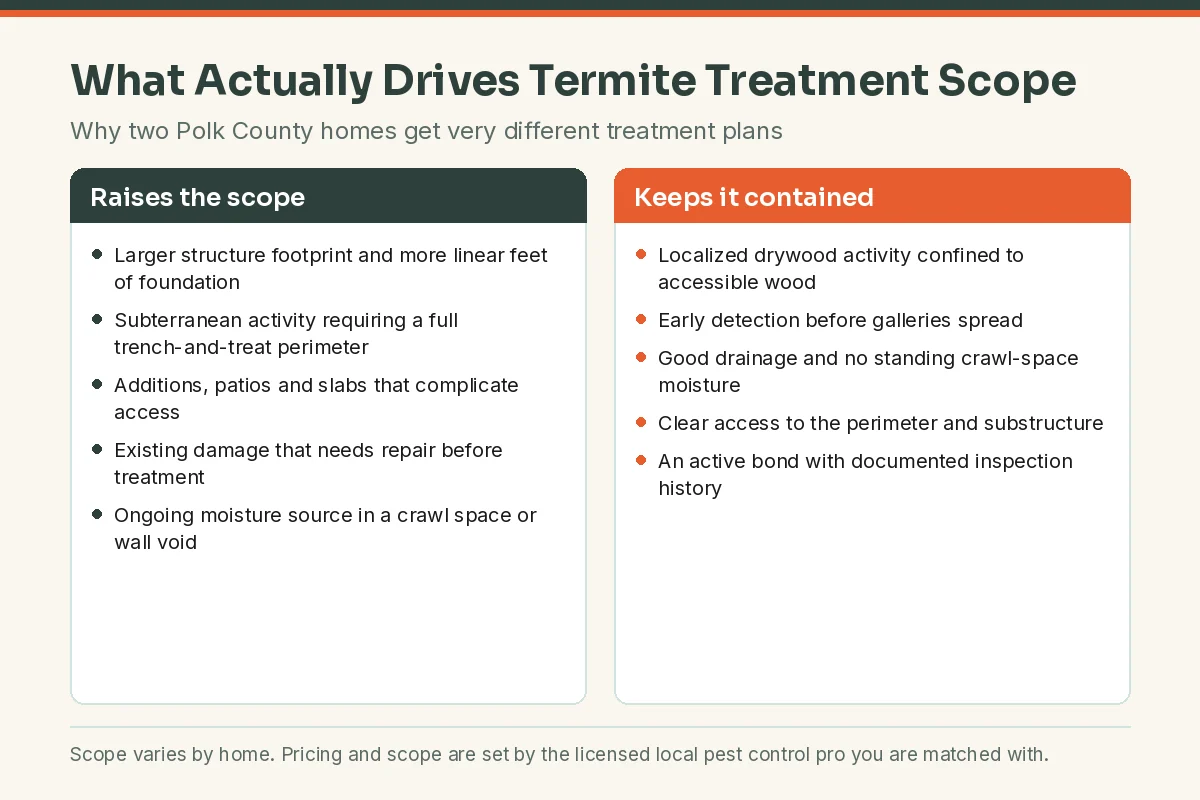
Two homes a few blocks apart in Lakeland can get very different quotes, and it usually comes down to a handful of factors rather than one company simply charging more than another.
- Home size and construction. A larger footprint means more linear feet of foundation to treat for a liquid barrier, or more stations around the perimeter for a bait program. Two-story homes, additions, and attached garages all add to the scope.
- Foundation type. Slab-on-grade homes — common across Polk County — often require drilling through concrete to reach the soil for a liquid treatment, which adds labor compared with a crawl space or pier-and-beam home.
- Which termite, and how established. A small, contained pocket of drywood activity is a very different job than widespread subterranean pressure with active mud tubes. The more established the colony and the more area involved, the higher the number tends to run.
- Treatment method. A localized no-tent spot treatment, a full liquid barrier, and an in-ground bait program are three different products at three different price points. The method that fits your home is a judgment the inspecting professional makes after looking at it.
- Access and obstructions. Patios, decks, dense landscaping, and slab penetrations all make it harder to reach the soil around the structure, which can move the price up.
None of these reflect a company being expensive for its own sake — they are the honest reasons the same two words, “termite treatment,” can produce very different quotes. Knowing them helps you read an estimate instead of just reacting to the bottom-line figure.
One call reaches a licensed, local exterminator who covers your address — and a real person answers, 24/7.
Subterranean vs. drywood — why the treatment (and price) differs
Because the two termite groups behave so differently, they require different treatments — and that’s the single biggest driver of why two quotes for “termite treatment” can look nothing alike.
Subterranean termites are a soil problem as much as a wood problem. The colony lives in the ground and depends on that soil connection. So the common approaches address the soil: a liquid treatment that establishes a treated zone the termites have to cross, or a bait system installed in the ground around the structure. The goal is to break the colony’s link to the home. Pricing tracks the size of the footprint that has to be treated.
Drywood termites live entirely in the wood, with no soil to treat. Historically the whole-structure answer has been tent fumigation. But because drywood colonies can be localized, a “no-tent” or spot treatment — targeting the specific infested members — is sometimes an option for confined activity. That’s why drywood situations produce such a range of prices: a small, contained problem treated locally is a very different ticket than a whole-structure approach.
The practical takeaway: when you get a quote, you need to know which termite you’re dealing with and which method is being proposed, or you’re comparing apples to oranges. A broader walkthrough of how local pros approach these decisions lives in the Lakeland pest control complete guide.
Signs you may already have termites in a Polk County home
Cost questions often start the moment a homeowner spots something they can’t quite explain. In Central Florida, where both subterranean and drywood termites stay active year-round, a few signs are worth knowing — because catching activity early usually means a smaller, less costly treatment than waiting until the damage is widespread.
- Mud tubes. Pencil-width tubes of dried soil running up a foundation wall, slab edge, pier, or interior baseboard are the signature of subterranean termites bridging soil to wood. They’re one of the clearest indicators of active subterranean pressure.
- Frass (drywood droppings). Small mounds of pellet-like droppings — often mistaken for sawdust or coffee grounds — beneath window frames, baseboards, or wooden furniture point to drywood termites living inside the wood.
- Discarded wings. A pile of equal-length wings on a windowsill, near a light fixture, or along a baseboard after a warm, humid day often means a swarm happened nearby and a colony is established close by.
- Hollow or papery wood. Wood that sounds hollow when tapped, or trim and baseboards that feel soft or look blistered, can indicate galleries eaten out from the inside.
- Sticking windows and doors, or bubbling paint. Moisture from termite activity can warp wood and lift paint, which is easy to mistake for ordinary Florida humidity damage.
None of these confirm the species or the extent on their own — that’s what an inspection is for. But if you’re seeing any of them, the cost conversation shifts from “should I budget for this someday” to “I should get this looked at now,” because the size of the eventual treatment usually grows along with the size of the problem.
What to ask so quotes are comparable
If you get quotes from two or three exterminators, the numbers will rarely line up — and that’s usually because the quotes describe different work, not because one company is overcharging. A handful of questions cut through it:
- Is this whole-structure or localized / no-tent? A spot treatment and a whole-home treatment are different products. Make sure every quote is for the same scope before you compare prices.
- Liquid barrier or bait system? These differ in upfront cost, how they work, and whether there’s ongoing monitoring. Ask which is being proposed and why it fits your situation.
- Is a renewable bond included, and what does it actually cover? Some quotes bundle a year (or more) of re-inspection and protection; others are one-time treatments with renewal sold separately. Ask what the bond covers, what the annual renewal costs, and what would void it.
- What did the inspection actually find? A quote should follow a real inspection of your home, with the findings written down. If a price is quoted before anyone has looked, treat that as a flag.
- Is the company Florida-licensed for this work? Pest control in Florida is regulated by the Department of Agriculture and Consumer Services (DACS). Confirm the exterminator is properly licensed before work begins.
Asking these turns a confusing pile of numbers into a real comparison. It also tells you a lot about how a company communicates — which matters when you may carry a bond with them for years.
One call reaches a licensed, local exterminator who covers your address — and a real person answers, 24/7.
FAQ
How much does termite treatment cost in Lakeland, FL? There’s no single number. Industry ranges put many liquid and localized no-tent treatments in the mid-hundreds-to-low-four-figures tier, with bait systems typically higher and a simple inspection more modest. The actual cost depends on the home, the termite type, and the method. These are third-party figures — your real quote comes from the exterminator who inspects your home.
What is “no-tent” termite treatment, and is it cheaper? No-tent (localized) treatment targets specific infested areas rather than fumigating the whole structure under a tent. It’s typically an option for confined drywood activity, not every situation. When it applies, a small spot treatment can cost less than a whole-structure approach — but whether it’s appropriate for your home is a determination the inspector makes.
What’s the difference between subterranean and drywood termites here? Subterranean termites live in the soil and reach the home through mud tubes; they’re usually treated with liquid soil barriers or bait systems. Drywood termites live entirely inside the wood with no soil contact and leave pellet-like frass; they’re addressed with fumigation or localized no-tent treatment. Central Florida has both.
How much is a termite bond in Polk County? Annual termite bond renewals are typically a modest recurring fee relative to the initial treatment, but coverage varies widely and the exact renewal amount is set by the operator holding the bond. Ask exactly what the bond includes — re-inspection frequency, what protection it provides, and what would void it — because the renewal price alone doesn’t tell you whether two bonds are equivalent.
Do I need a termite inspection before buying a home? Often, yes. Even when it isn’t required, it’s worth doing for the peace of mind. See the Polk County WDO reports overview for how the report works.
Why are my quotes so different from each other? Usually because they describe different work — a localized spot treatment versus a whole-structure treatment, liquid versus bait, with or without a bond. Make sure every quote covers the same scope and method before you compare the bottom-line numbers.
Are these prices fixed or promised? No. Every figure on this page is general third-party industry data meant to help you plan. It is not a quote and nothing here is a price offer. A licensed exterminator has to inspect your home to give you an actual number, and that quote is strictly between you and them.
One call reaches a licensed, local exterminator who covers your address — and a real person answers, 24/7.
LakelandExterminators.com is a dispatch and matching service. We connect callers with independent, licensed Florida exterminators; we are not a licensed pest control company ourselves. Any reference to prompt or same-day response describes typical scheduling of matched independent providers and is not guaranteed — actual response times vary by provider, season, location, and demand. See our full disclaimer in the site footer.